Sunday, June 5, 2011

Oma-huh? How college basketball and The Pope can help make the College World Series better


We all have that friend.

We all have that friend from high school who seemed way more talented than he ever let on. We all know that he could have gone on to do bigger and better things. After high school, everyone went on to college or simply moved out to experience new life in a new place.

But not that friend. That friend stayed at home, took a job in his hometown, and never left. He married his high school sweetheart, had a couple of kids and seems pretty happy with his lot in life. He never once questioned why he needed to leave, never bothered to really grow beyond the town he lived in.

Everyone knew that friend could have done more and had greater success in life. Everyone except that friend.

College baseball, sadly, is that friend and Omaha, Nebraska is its hometown.


Omaha is actually a really nice city, and I don't just say that because the picture is pretty. It's a charming Midwestern city with a killer downtown lined with cobblestone streets and parks lining the Platte River. Exceptional microbrews can be quaffed at the Uptown Brewing Company while you shoot billiards upstairs. The city is littered with some of the world's greatest steakhouses and it also boasts an absurdly underrated live music scene. Rock/reggae stars 311 are probably Omaha's most famous musical alum. The city also boasts one of America's best jazz scenes.

Furthermore, Omaha is a major financial sector, perhaps one of America's most noteworthy. Warren Buffett still makes him home there as does TD Ameritrade. It's noteworthy that the latter has the sponsorship deal for the new baseball stadium in Omaha that houses both the Kansas City Royals triple-A minor league affiliate and the College World Series.

But none of this really matters. Simply put, Omaha does not have the national cache that other cities possess. In Midwestern terms, it lacks the major metropolitan quality of Chicago, the history of St. Louis or the quirkiness of Minneapolis. Omaha is basically the Midwest's equivalent to Albuquerque. Sure, it may be vastly underrated but when was the last time you heard of anyone aspiring to travel or move there? Ask yourself this question: With the exception of the College World Series, when was the last time you heard anyone get excited about going to Omaha?

Unless they have friends or family in the area, the answer is "probably never."

When people think of Omaha, they probably think of three things: Insurance, steak and college baseball. Omaha isn't a glamorous place, and it doesn't aspire to be. That doesn't make Omaha a bad place at all, not by a long shot. But if college baseball wants to be a little more glamorous, a little bit more like their money-making college football and basketball friends, it needs to leave the smallish city behind and think big.

Real big. College baseball can totally reinvent itself as a major player in the sports world if it follows the following steps.

1. Infect people with the June Bug

College basketball has the insanity called March Madness. College baseball could have something similar called the June Bug. It starts with making sure their conference tournaments are televised on visible networks like ESPN. Not ESPNU, not Vs., not the regional Fox Sports broadcasts. College baseball, especially tournament play, needs to make sure that they are more visible on ESPN and ESPN2.

March Madness doesn't start with the NCAA tournament, of course. It starts with the conference tournaments that are televised ubiquitously starting in March. The major upsets, the buzzer-beaters and the improbable story lines in conference play are all just appetizers to the NCAA tournament, an event that has improbably become the second biggest sporting event in America, next to only the Super Bowl in terms of overall coverage and national interest.

Furthermore, has college baseball ever televised the live announcement of their bracket? Why not? What's the harm in a partnership with ESPN where they announce the College World Series bracket in an hour-long special before the Sunday night baseball game? Has the NCAA even considered doing something like that? If it's a matter of money or even prior contractual obligations that the folks in Bristol may have, that's one thing. But it's not clear that the NCAA has even considered marketing their sport in the same manner that March Madness is currently packaged. If this has never been considered, simply put, that's completely inexcusable by the NCAA. Considering the fact that we may not see the NBA and NFL play their next respective seasons, it is unfathomable to think that the NCAA wouldn't want to have as many captive sports fans tuning into their product as possible.

2. Restructure where the games are played

One of the great appeals of March Madness is that it truly feels like a national event. The regions are divided into four distinct quadrants and action is happening all across the country. No matter where you are in America, it feels as if you're not that distant from the action.

But for the first round of the College World Series, known as the "super regional," these games are played on college campuses. These games are rarely televised, and even less publicized. Again, why?

The College World Series could market the June Bug by selling the venues they play at as a part of the event itself. This is, frankly, nothing new and has been common practice in the world of sports, entertainment and even religion.

Consider this. When Pope Benedict XVI came to America in April 2008, he celebrated Mass at St. Patrick's Cathedral in New York City. He also celebrated Mass at Nationals Stadium in Washington DC. But nothing compared to the national attention he received when he celebrated Mass at Yankee Stadium. This Mass was televised worldwide on CNN and much ado was made about where the Pope was going to conduct Mass (right around second base as it turns out). Was the Mass inherently different or somehow unorthodox than the Masses he celebrated elsewhere. Probably not.

But the major difference was the venue itself. Honestly, it just sounded incredibly important. Pope Benedict XVI at Yankee Stadium sounds quite a bit better than Pope Benedict XVI at Nationals Stadium. It sounds like an event.

Since that Mass, the NHL has begun televising a New Years Day game from football and baseball stadiums outdoors. The NHL recognized what the Pope understood. A Bruins-Flyers game live from Fenway Park on New Years Day just sounds like something you need to see. It sounds special. The action and proceedings may not be any different, but it feels like it should be.

College football has adopted this mentality as well. Illinois played Northwestern last season from Wrigley Field. No one aside from Illinois and Northwestern grads would have cared even one iota about this match-up had it been played in Champaign or Evanston. But because Illinois and Northwestern were playing at Wrigley Field, somehow it felt much more important even if both squads were afterthoughts in the Big 10 conference.

The College World Series live from UFCU Disch-Falk Field in Austin or TD Ameritrade Stadium in Omaha does not sound like an event. It sounds like an ordeal. To that end, the College World Series needs to restructure these games in a three-tiered format.

A: Move the "super regional" games off the college campuses and into minor league stadiums. Bill these games as "The Beginning," not unlike "the beginning" for most Major League Baseball players. It is the starting point in the journey, not the final destination. College basketball does this very well. The opening rounds usually give lesser-known cities like Tulsa, Boise and Greensboro a chance in the spotlight before moving on to the next rounds of play.

High-tech minor league stadiums in cities like Austin, Memphis and Albuquerque have developed and would make fantastic choices for opening round games.

B: Move the traditional rounds that take place in Omaha to major league stadiums. This could be dubbed "The Big Time," similar to how a player feels when he gets called up to the Majors.

Traditionally, in Omaha, eight schools are split into two, four-team, double-elimination brackets, with the winner of each bracket playing in the best-of-three championship series. Why not divide the two brackets into a North and South or East and West regional taking place in major league stadiums?

What sounds better to you? Texas and LSU live from Coors Field in Denver? Or Texas and LSU live from TD Ameritrade Park in Omaha? What sounds more important? It's the same product but what sounds a bigger deal?

Furthermore, it wouldn't be that difficult to schedule either. All the NCAA needs to do is find out when the respective major leagues won't be in town and schedule games accordingly. These games could be rotated throughout various stadiums over the years. Unless they are one of the Final Four, if you will.

C. The final two schools in the College World Series meet at one of baseball's four greatest stadiums. Fenway Park, Yankee Stadium, Wrigley Field and Dodger Stadium would be on rotation yearly for the College World Series not unlike how the BCS currently structures the national championship game for football between the Rose, Fiesta, Sugar and Orange Bowls. The College World Series would play out in a best-of-three format in baseball's most important, most cherished venues.

Again, what sounds better? Texas and LSU live from Yankee Stadium for a deciding Game 3 of the College World Series? Or Texas and LSU live from TD Ameritrade Park in Omaha for a deciding Game 3 of the College World Series? What sounds like it should be more important? And which would you rather watch?


Our friend, college baseball, has great potential. On May 31, 2009, our friend showed perhaps its greatest potential to date. Texas and Boston College played an unthinkable twenty-five inning game. Texas reliever Austin Wood pitched an absurd 12 1/3 innings of no-hit ball and delivered the Longhorns a 3-2 victory over the Eagles at right around the same time the bars were beginning to close on 6th Street.

This game should be the stuff of legend and lore. When people talk about the greatest games of all-time of any sport, this game should be near the top of every sports fans list. It is the longest game in college baseball history, and it featured one of the greatest pitching performances the game has ever seen or will ever seen again.

But it will never be mentioned. The game was never televised. The audio was never preserved or if it was, it certainly hasn't seen the light of day by way of a Google search. The game was played in front of about 7500 people in Austin. Consider for a moment how awesome it would have been for every sports fan in America to tune in on ESPN, realize what was happening and call everyone they know that they have to watch this game.

A 25-inning game that features over 12 innings of no-hit baseball isn't a game. It's an event. It's a heart-rendering event that should have defined guts, grit and glory. It should have defined every possible reason America loves sports and loves baseball. But our friend, college baseball, stayed tucked away in the spotlight, not caring to publicize itself and losing potentially millions of fans in the process.

But college baseball doesn't seem to care. It seems pretty content with its new digs in Omaha. And it seems pretty happy with the crowds they get.

But college baseball could be doing better. Way better, in fact.

They'll never know until they leave home.

Tuesday, March 22, 2011

It's Time: Why Rick Barnes Needs To Leave Texas & Who Should Replace Him


I was 21-years-old when I first met Coach Barnes. I was an intern for the local sports radio station, and I was asked to operate the mixing boards for his statewide call-in radio show. At the time, the show was being broadcast from a banquet area of a now non-existent steakhouse in south Austin.

Nobody asked him questions while I was there. No one walked up to him in all the time I worked with him to congratulate him or criticize him. Perhaps people were too shy to say anything, but I know one thing for sure: If Mack Brown had a call-in radio show from a steakhouse, people would damned well would grill him like a well-done t-bone. The Burnt Orange Faithful would undoubtedly make Woodward and Bernstein look like The Chris Farley Show when it comes to their line of questioning. It goes with the territory and the salary, and I have no doubt Coach Brown knows that.

Perhaps it's more accurate to suggest that no one gave a damn about Texas basketball until Coach Barnes got there. And that's really the greatest compliment anyone can give him. Suddenly, Texas basketball in March has become as routine as Spring Breakers in South Padre and the bluebonnets in Brenham.

Under Coach Barnes' 13-year tenure as head coach, the Longhorns have yet to miss the NCAA Tournament. By way of comparison, North Carolina, one of college basketball's greatest programs has missed the NCAA tournament twice in the last ten years. Expectations have been raised significantly and so has his salary. He's now one of only eight college basketball coaches who commands $2 million a season, but has only made the Final Four once and that was almost ten years ago.

He's currently in the same earning fraternity with gentlemen like Florida's Billy Donovan, Connecticut's Jim Calhoun and North Carolina's Roy Williams all of whom have won multiple national championships. Barnes is currently making more money than Michigan State's Tom Izzo who has won a national championship and has been to six Final Fours. Barnes is also earning more than Duke's Mike Krzyzewski, and Krzyzewski may be the greatest college basketball coach alive.

It's not always, and it shouldn't always be about the money, but the reality is that Rick Barnes is making elite-level money and doesn't have anywhere near the resume that his similarly salaried peers have. And he's doing less with more talent than any other coach in the country.

Current NBA scoring leader Kevin Durant was paired with current Charlotte Bobcat PG D.J. Augustin for the 2006-2007 Longhorn basketball season, and could only muster a first round win in the tournament to New Mexico State. They were crushed in the next round by USC 87-68. Durant turned pro almost immediately afterwards.

Since that season, Texas has only made it past the second round of the tournament once despite boasting an impressive four first-round NBA draft picks (Durant, Augustin, Avery Bradley and Damion James). Moreover, it hasn't just been losing early that has been frustrating, it's been the way they lost--the complete lack of fundamentals--that have contributed to these early exits.

Consider, for example, the startling the plunge of the 2009-2010 Longhorn team that was ranked #1 in the country for a time, but then tanked the season and landed in the dreaded 8-9 match-up against Wake Forest. Simply put, this team absolutely could not make a free throw with a gun to its collective head. The 2009-2010 team shot an abysmal 63.3 percent from the free throw line. This ranked them a staggeringly awful 325th in the country that season for that particular statistic. This season Texas "improved" their free throw shooting percentage to 65.4 percent, good for 285th in the country. Both seasons they finished dead last in the Big XII in free throw shooting percentage.

This is compared to the same disappointing 2006-2007 team that shot 73.6 percent from the line, good for 35th in the country.

The following simply cannot be explained away: Free throw shooting, perhaps the most basic and fundamental aspect of basketball, has declined almost a full ten percentage points in four years under Rick Barnes' watch. That is simply inexcusable especially given the depth of talent that Texas has seen over the course of that period of time.

The lack of fundamentals has lead to disappointments like losing that aforementioned game to Wake Forest on an overtime buzzer beater in 2010 after missing two free throws. And it also lead to Arizona outing Texas this year in the second round of the tournament.

Whether or not Cory Joseph's ill-fated timeout was actually made before he committed a five-second violation is moot. Not only did the Longhorns lose the game, but frankly, Joseph should have never gotten that close to a five-second violation in the first place. The fact that such a struggle took place to inbound the ball in a pressure situation again comes down to lack of fundamentals, and further, a lack of execution.

That lack of execution is directly related to a lack of quality coaching. A better scheme should have been in place. And if the better scheme wasn't in place, a better decision could have and should have been made. But it wasn't. Consequently, the 2011 Texas Longhorns season ended with a loss and unnecessary controversy.

But how is all of this possible? It's not as if all of a sudden a man who has won 524 basketball games all of a sudden completely forgot the most fundamental elements of the game. Furthermore, Barnes has won on average 25 games a year at Texas. Let's say that he continues to coach at Texas for another eight years, and averages the same number of wins. He would have 722 wins for his career, good for top 20 all-time in college basketball history. Furthermore, some of the names he would surpass like UTEP's Don Haskins and Louisville's Denny Crum are enshrined in Springfield.

Is it possible that the Longhorns would go out of their way to evict a possible Hall of Famer? Or perhaps a better way to phrase the question: Is Coach Barnes coaching like a Hall of Famer right now?

It would be unfair to say that the program has slid backwards considering that the Longhorns have become a fixture of tournament brackets and office pools every March. But it's perhaps more accurate to say that Texas basketball has plateaued over the course of the last five seasons, and that new ideas and a fresh approach is necessary to advance the program forward to the elite levels that match the talent.

It's not even a rip on Coach Barnes either. Larry Bird wisely ducked out of the Indiana Pacers coaching job after only three seasons. Bird won a Coach of the Year award and was offered an extended contract, but declined stating that three years was long enough. Anything after three years and the players start tuning out the coaches.

The NBA is no question structured differently, but the principle remains the same, and this isn't just true in basketball, but in business as well. Corporate leaders face the ax on a daily basis if they can't reach their employees in an effort to improve their profits and market share. Many well-educated and knowledgeable leaders face termination if the numbers aren't satisfactory and that's not because they all of a sudden forgot fundamental business theories or just blanked on their latest presentations to the stockholders.

Sometimes in life, a new voice is needed to move teams--sports or otherwise--towards a greater direction. It's not to suggest that what the leader before did was bad or flawed. It's just tired. And right now, Coach Barnes is tired. The Longhorns look tired. And losing consistently in the tournament with a higher level of NBA talent than most schools will ever dream of is tired.

I don't doubt for a second that Coach Barnes will be successful elsewhere. He took Texas out of the doldrums of the Tom Penders era, and made Texas a consistent presence in the NCAA Tournament. Texas is now a destination school for elite talent, and that's not something that was the case before Barnes arrived in Austin.

The program has had nary a violation or run-in with the NCAA about much of anything. With the exception of Alexis Wangmene's February 2011 DWI arrest, Texas basketball players have, by and large, remained out of the police blotter.

But that could be said about Duke. Or North Carolina. Both programs have excelled on and off the court and in the classroom as well. In 2010, Duke and North Carolina graduated 92 and 75 percent of their players respectively compared to just Texas' 47 percent. In fact, this is one of the few numbers that the Longhorns have actually improved on during the last five years of Barnes' tenure. Texas basketball's graduation was a paltry 40 percent in 2006 so this has at least been an improvement in some regard.

But it's nowhere close to being good enough. That's why it's time.

It's time for a change in leadership for Texas basketball. It's time for new ideas and a fresh face to emerge in Austin. It's time for March to bleed into April with the Horns still alive in the Final Four. It's time to schedule crawfish boils around net-cutting ceremonies, and it's time for 6th Street to explode with raucous joy not normally seen on a Monday night. It's time for One Shining Moment to be sung by Willie Nelson.

But that time may never come if the status quo doesn't change. For that status quo to change, Texas needs someone already proven, somebody young and somebody willing to build a dynastic legacy in Austin. Texas needs someone that can manage the sometimes dizzying expectations of the school, understands the scrutiny, and can still manage the madness surrounding every March.

One small problem: The best man for the job is still in the tournament right now. And he normally resides in Indianapolis.


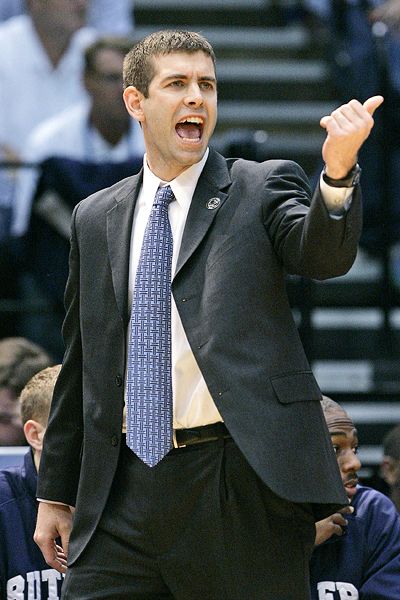
Brad Stevens of Butler has already accomplished more than Rick Barnes at least in one sense. Both have one Final Four under their belt, but Stevens took it one step further in 2010 and made it to the national championship game, losing by a fraction of an inch to Duke 61-59.

He has collected two 30-win seasons in his four-year tenure at Butler, and won't turn 35 years old until October. Butler is back in the Sweet Sixteen again this year after knocking out the #1-seeded Pittsburgh Panthers, marking the second year in a row that Butler has trumped a one-seed in the NCAA tournament.

Unthinkably, Stevens has transformed a tiny school in Indianapolis with an enrollment of only 4,200 into what is likely the best basketball school in a state famous for Bob Knight, Jimmy Chitwood, Larry Bird and John Wooden.

Butler is still competing in the tournament whereas Purdue, Notre Dame and Indiana State all made early exits. The legendary Indiana Hoosiers have become an afterthought and haven't seen the Big Dance in years. The Bulldogs has become The Big Dogs in the state of Indiana, but the question remains: How long can a school with such a tiny enrollment afford to keep him?

Stevens is a native Hoosier, and his contract with Butler extends well into the next decade, but his salary only pays him roughly around $750,000 for the 2009-2010 season. No doubt that's outstanding money for just about anyone, but given the amount of money Longhorn boosters have been known to throw around, it's certainly not inconceivable for them to have Barnes' contract bought out and pay Stevens double what he's currently making now.

Perhaps triple or quadruple his current salary if he can light the tower orange in April.

It's certainly unnerving to so casually toss money around in such flippant ways--a million here, two million there--but the facts are that Texas, as it stands, is vastly overpaying Rick Barnes. The results don't justify the cost. If you're going to spend that kind of money, you might as well at least go after someone who has already accomplished as much, if not more than Barnes has. No one wants to be accused of the being the Yankees of college athletics, but the money is already being spent. It would be wiser economically to invest in someone that is currently delivering more anyway.

And make no mistake, the late John Wooden, who won more championships than any other college coach in history said about Stevens, "I enjoy watching [Stevens] and very much enjoy [Butler's] style of play." President Obama called Stevens after the national championship to congratulate him. Butler, of course, lost that game and the President still thought he did a great job.

If Coach Wooden singled you out for your exemplary coaching job, if the President of the United States wants to talk to you after you lost, you're doing something right.

Texas would do right to at least introduce Brad Stevens and his family to the 40 Acres, Zilker Park, bluebonnets, brisket and Shiner Bock. I know he said that he wouldn't leave Butler unless they kicked him out. But Austin has a funny way with people once they get here. They come from all over Texas and the United States, and once they get here, they don't typically leave.

Therefore getting kicked out may not be necessary for Brad Stevens. The same can't be said for Rick Barnes.

Tuesday, December 8, 2009

Mr. Irrelevant: Why It Won't Matter Who Notre Dame's Next Coach Will Be


Right now, it's 33 degrees in South Bend, Indiana. A mixture of sleet is expected later this evening. This news can't be much of a surprise to anyone who's been there. The average high temperature in the city doesn't even get above 60 degrees. In a nation that's getting increasingly weary of the cold, in a nation that seems to be moving further south and west, that doesn't bode well for future growth and economic prosperity.

And it hasn't.

South Bend's population dwindled to 103,807 in July 2008, down 3.7 percent from the 2000 census. 22.3 percent of those nearly 104,000 people lived 2007 in poverty, including 38.1 percent of the community's African-American population. The estimated median household income in 2007 was only $34,774 well below the Indiana state average of $47,448.

But still South Bend attracts some of America's brightest teenagers to attend the University of Notre Dame. Their academic prowess is renowned the world over as it possibly the finest Catholic education this side of Vatican City. However, that is starting to slip as well. In 2009, Notre's Dame law school fell out of the US News and World Report's Top 25 for the first time in six years and actually ended up tied with their southside public brethren, the University of Indiana. Their MBA program has slid all the way back to 34th, and can't even be considered the best MBA program for a Catholic university any longer. Georgetown and Boston College both rank higher in the same 2009 US News and World Report survey, 22nd and 32nd respectively.

Most don't recognize these facts, though. Most are only aware of Notre Dame's struggles as a once-powerful college football giant struggling to regain the tarnished luster that used to be about the Four Horsemen, Win One For The Gipper, Joe Montana and Touchdown Jesus.

What it seems to be about now, much like the city of South Bend and its academic reputation, is decline. It seems to be about a football program that boasts an impressive 11 national championships but hasn't won a New Year's Day bowl game since 1994. It seems to be about 119 seasons with a winning percentage of .733, but only has a winning percentage of .575 since 1997. It seems to be about the Chicken Soup game and the Catholics vs. Convicts matchup, but is now more famous for the Bush Push contest.

Notre Dame won the first aforementioned two. They lost the aforementioned third.


South Bend, Indiana is a two-hour car ride from the nearest major airport, Chicago's Midway. It's a little longer if you want to fly into O'Hare, and a lot longer if you get stuck in Chicago's notorious traffic jams. For many recruits, both academic and athletic, Notre Dame is definitely not the easiest place to get to. Certainly, there are harder campuses to get to that play Division I football, but there's also a reason why they aren't traditional powerhouses.

Pullman, WA is the home of Washington State University, but even Washington State residents would have a hard time finding it on a map. It's almost two hours southeast of Spokane, practically sitting on the chimney of Idaho in the extreme east corner of the state. Right now, it's 12 degrees in Pullman.

It will be 16 degrees there tomorrow.

Starkville, MS is the home of Mississippi State University, and its athletic program has at least one thing going for it. 14,991 people made their way to Dudy Noble Field, Polk-DeMent Stadium to see the Bulldogs play baseball against the University of Florida on April 22, 1989. That game still holds the NCAA baseball on-campus attendance record. While it is widely regarded as one of the best places to watch a college baseball game, unless you live around Starkville chances are you're probably not going to see a baseball game there. Starkville is about two hours, fifteen minutes from the nearest significant airport in the state capitol of Jackson. It's about two hours, thirty minutes from Birmingham, AL.

Washington State and Mississippi State's combined football record since 1990 is 110-237. They've both had some good moments, of course. Washington State made two Rose Bowl appearances since 1990, once in 1998 and another in 2003. They lost them both.

Mississippi State made the 1998 SEC Championship game. They lost that game to Tennessee 24-14. Their consolation prize was a matchup with traditional powerhouse Texas in the Cotton Bowl. They lost that too 38-11.

While anomalies certainly exist in the college football hierarchy, it would appear that location, specifically the proximity to an airport of significance, does play a major factor in 21st century success.

The following is the final BCS Top 10 ranking. In parentheses is the distance from the airport of nearest significance and the major carrier that flies there. A major international hub is duly noted.

1. Alabama (Birmingham Int'l Airport--approximately 56 miles from campus/Southwest)
2. Texas (Austin--same city/Southwest)
3. Cincinnati (Same city/Delta)
4. TCU (Fort Worth--Dallas-Fort Worth International Airport/Major Hub)
5. Florida (Jacksonville--approximately 113 miles/Southwest)
6. Boise State (same city/Southwest)
7. Oregon (Portland--approximately 110 miles/Southwest)
8. Ohio State (Columbus--same city/Southwest)
9. Georgia Tech (Atlanta/Major Hub)
10. Iowa (Des Moines--approximately 112 miles/American)

What we can discern from the Top 10 is that majority of the schools are located right next to airports that are nearby, if not in the same city. The schools that aren't certainly have plausible explanations for their success. Gainesville is centrally located in Florida, and they are right in the middle of what is arguably the most fertile recruiting base in the country. Alabama is much the same way especially with their traditional degree of success in the football-mad southeastern region of the country.

Oregon has benefitted from their most famous graduate, Nike founder Phil Knight, dumping millions of dollars of his fortune into their athletic program and sparing no expense in turning the Ducks' training facilities into a gridiron palace that rivals the best of the NFL.

The only genuine anomoly of the Top 10 is Iowa, and their coach, Kirk Ferentz, has been long regarded as one of college football's best coaches. Due to his NFL ties, he has long been rumored to return to his roots, but has yet to do so.

Much like real estate, college football success as we approach 2010 is predicated greatly on location. Either the campus had better be readily accessible by airplane or the campus should be centrally located in area visible to top recruits if constant BCS attention is desired. Furthermore, half of the schools, including four of the top five in the BCS Top 10, are located in what are thought of traditionally as warm-weather climates. In a day and age where Americans are leaving colder climates in droves due to both economics and just plain ol' bad weather, it makes sense for top recruits to follow the current sociological trend as well.

Washington State and Mississippi State both recognized these trends years ago, and are content to enjoy the success they receive from time to time.

Meanwhile, Notre Dame just rejected a bowl offer, and will not be playing in the 2009 postseason. Just like Washington State and Mississippi State.


He has been sarcastically called Saint Tebow of Nazareth. But Florida quarterback will walk away from college football as one of the all-time greats. He has won one Heisman Trophy, possibly another on Saturday and has won two national championships. And he also wears divinity on his face. Literally.

Tebow has been known to sport eyeblack referencing John 16:33 which states, "These things I have spoken unto you, that in me ye might have peace. In the world ye shall have tribulation: but be of good cheer; I have overcome the world."

His Christian devotion is so famous that he even managed to recruit his head coach, Urban Meyer, to travel with him for one of his mission trips to the Dominican Republic.

Tebow's comparably famous counterpart, Texas Longhorn quarterback Colt McCoy, is nearly as successfully and devoted to the Christian faith as he is. McCoy, who is considered the front-runner for the 2009 Heisman Trophy, became college football's all-time winningest quarterback this year.

He, like Tebow, also has traveled significant distances for missionary work. McCoy has spent past Spring Breaks in Peru doing humanitarian work, and still manages to find time to visit local Austin children's hospitals as well.

Notre Dame has long prided itself on being not just a top-tier university or just a top-tier football program, but on producing top-tier student-athletes. While there are certainly a fair number of programs that allow sketchy characters to play football at their respective universities, it is also clear that football players do exist that excel both at the highest levels of athletics and their devotional calling. So why couldn't Notre Dame land either Tebow or McCoy? They may not necessarily be Catholic, but they would certainly embody many of the traits that Notre Dame is looking for.

At first glance, the obvious answer is proximity. Tebow and McCoy are from Florida and Texas, respectively. But there are other reasons too.


The first two pictures are obviously Tebow's female admirers. The third picture is reportedly Colt McCoy's girlfriend.

Is it to suggest that girls that are as attractive as the following three are impossible to find at Notre Dame? No, but all you need to do is go to virtually any Southern school in the country to know that the girls are quite a bit more attractive than the norm due to, in large part, the better weather. Even as devoted as Tebow and McCoy are to their Christian faith, let's face it, they are still young men who know how well they have it in the South. The beautiful weather, the good-looking girls, the chance to lead a football powerhouse, and a chance to nurture their spiritual nature all without having to leave home?

Isn't the decision a no-brainer for Tebow and McCoy? And if you're the next Notre Dame head coach, well...could you blame them?


That next Notre Dame head coach has been rumored to be Cincinnati's Brian Kelly. He has lead the Bearcats to an undefeated record this season and a Sugar Bowl showdown against Tebow's Florida Gators. Should he accept the job, no doubt it will be a tremendous pay raise. But along with it, he will have to accept an enormous degree of obstacles along the way. He will have to accept that the job he's taking is located in an economically depressed city in an economically depressed part of the country that's pretty hard to get to. He will have to find recruits that not only can pay only devotion to Christ, but can pay no mind to nearly five months of winter.

And Notre Dame should accept the fact that as we head into a new decade, their football program may not be what it once was, and may never be again. Meyer along with former Super Bowl winning coach Jon Gruden declined interest in the Notre Dame opening five years ago. Perhaps it's because they knew all of these truths, and knew Notre Dame was unwilling to accept these truths to be self-evident. Perhaps they recognized that Notre Dame should reassess itself as an academic powerhouse, and reestablish itself as the world's preeminent Catholic university.

Perhaps they both recognized that Notre Dame's football program is closer to Stanford and Northwestern than Florida and Texas, and that distinction is actually something to be proud of, not to be scoffed at.

But the Fighting Irish refuse to believe that. So Notre Dame is entrusting Brian Kelly to wake up the echoes, sounding Her name.

And if he fails? Then Notre Dame football will always be exactly that.

Just an echo.